Monday, 26 August 2019

Last date to file GST annual returns extended till Nov 30

New Delhi, Aug 26 The finance ministry on Monday said the last date for filing annual GST returns has been extended by three months to November 30 as taxpayers were facing technical problems in furnishing returns.
Earlier, GST taxpayers were to file required returns by August 31.

"It is hereby informed that the last date for furnishing of annual return in the Form GSTR-9 / Form GSTR-9A and reconciliation statement in the Form GSTR-9C for the financial year 2017-18 is extended from August 31, 2019 to November 30, 2019," the Central Board of Indirect Taxes & Customs (CBIC) said in a statement.

GSTR 9 is an annual return to be filed yearly by taxpayers registered under the Goods and Services Tax (GST). It consists of details regarding the outward and inward supplies made or received under different tax heads.
While extending the date, the CBIC said "certain technical problems are being faced" by the taxpayers as a result annual return for the period July 1, 2017 to March 31, 2018 could not be furnished by persons registered under GST.

GSTR-9C is filed by those whose annual turnover exceeds Rs 2 crore. It is a statement of reconciliation between GSTR-9 and the audited annual financial statement, while GSTR-9A is the annual return to be filed those who have opted for the Composition Scheme under GST.


What is the consequence of non-filing the return? 
Failure to file annual return shall attract a late fee of INR 200 per day during the period of failure, subject to a maximum of 0.25% of the said Financial Year's turnover. 

Whether the annual return can be revised 
As there is no specific provision in GST law to revise the annual return hence, based upon the current version of the law, it appears that once filed the same cannot be revised. 


Need any assistance than 


Monday, 8 July 2019

Section-80CCF and Section 80CCG


Section 80CCF of the Income Tax Act is a special provision introduced for benefiting the investors of certain government-approved bonds schemes. The section was discontinued w.e.f AY 2013-2014. Section 80CCF was formulated in the year 2010 and came in force in 2011 under the income tax act.The deduction is avaliable to Indian resident,Individuals, HUFs and Minors also shall be take the benefit for this deduction. The minimum investment must be Rs 5,000. The is no higher cap limit, however the deduction limits to Rs 20000. The bonds must have a 5 year lock-in period. Sometimes companies offer buyback options wherein the investor can surrender the bonds after 5 years without up giving up his interest income. These bonds are listed on the stock exchange


T
      These bonds are issued by infrastructure companies seeking approval of the government, and they offer a decent rate of interest plus additional tax benefits.Corporations like the Life Insurance Corporation, Integrated Infrastructure Finance Company, Industrial Financial Corporation of India, and non-banking financial institutions which are approved by the government as infrastructure companies.The benefits of Section 80CCF are over and above that of Section 80C.


Investors should remember that Section 80CCF applies only to certain investments.

Let us consider an example for better understanding

Mr Sunil, aged 30, works in a company, has earned a salary of Rs 7.5 lakhs this year. As per the income tax slabs, he is liable to pay tax on the amount exceeding Rs 2.5 lakhs, i.e. on Rs 4 lakhs. In order to reduce his tax liability, he invests Rs 100000 in schemes eligible for the deduction of section 80C. The limit of section 80C is Rs 1.5 lakh

Thus, now his taxable income at Rs 4 lakhs minus Rs 1 lakh = Rs 3 lakhs

Further, he also invests in government approved infrastructure bonds worth Rs 30,000.

Such bonds being eligible for deduction u/s 80CCF reduces his taxable income to Rs 3 lakhs minus Rs 20,000 = Rs 2.8 lakhs as the deduction u/s 80CCF is up to Rs 20,000.


Thus, we can see that Mr sunil has reduced his tax liability considerably.


Section 80CCG

Deduction under section 80CCG has been discontinued starting from 1st April 2017.

The Rajiv Gandhi Equity Savings Scheme was introduced in Budget 2012. This deduction was over and above the 80C deduction available to individuals


THEREFORE, the conditions under section 80 CCG for claiming deduction would be :–
  The gross total income of the assessee for the relevant assessment year should be less than or equal to ₹ 12 lakhs.
  The assessee should be a new retail investor as per the requirement specified under the notified scheme.
The investment should be in such listed equity shares or listed units of equity-oriented fund specified under the notified scheme.
The minimum lock in period in respect of such investment should be three years from the date of acquisition 

 Tax Benefit
The deduction was 50 % of amount invested in such equity shares or ₹ 25,000, whichever is lower. The maximum Investment permissible for claiming deduction under RGESS is Rs. 50,000. The benefit is in addition to deduction available u/s Sec 80C


Mr A, new retail investor, have made the following investment in equity share/units of equity oriented fund of Rajiv Gandhi Equity Savings Scheme for the Previous year 2012-13,2014-15 and 2015-16 as below :
Particulars
P.Y 2013-14
P.Y 2014-15
P.Y 2015-16
Investment in listed equity shares
₹ 15,000
₹ 42,000
₹ 30,000
Investment in units of equity oriented fund
₹ 45,000
₹ 12,000
Sale of all units of equity oriented fund purchased in P.Y 2013-14
₹60,000
Gross Total Income (comprising of salary income and bank interest)
₹11,50,000
₹11,75,000
₹12,25,000
Deduction under section 80 CCG
₹ 25,000
₹21,000
Nil
Remark
(Restricted to 50 % of ₹ 50,000)
(Restricted to 50 % of ₹42,000)
(Not eligible since GTI exceeding   ₹12,00,000
Amount liable to tax (on account of violation of condition)
₹ 22,500
Note :-  Since the deduction under section 80 CCG was not allowed during the P.Y 2015-16 on account of the Gross Total Income exceeding ₹ 12 lakhs, no amount relating to that year can be subject to tax in the P.Y.2012-15, being the year of violation of condition, even though the units were sold within 3 years. However a deduction of ₹ 22,500 (50 % of ₹45,000) was allowed under section 80 CCG in respect of investment of ₹15,000 in units of equity oriented fund in the P.Y,2013-14. Since such units have been sold in the P.Y. 2014 -15, the condition under section 80 CCG has been violated and ₹ 22,500 would be subject to tax in the P.Y.2014-15.


Friday, 5 July 2019

Budget 2019 Highlights: Union Budget Highlights


The budget has been presented with a 10-year vision in mind. The startups are being given a whole set of tax benefits.
-The budget is for a New India has a roadmap to transform the agriculture sector of the country, this budget is one of hope, says Narendra Modi
-Fully automated GST Refund module shall be implemented; multiple tax ledgers to be replaced by one; invoice details to be captured in a central system
-Basic customs duty on certain items to be increased to promote the cherished goal of Makein India. Import of defence equipment not manufactured in India are being exempted from basic customs duty.
-The government today increased customs duty on Gold. According to the Budget proposals, import duty to be hiked on gold and precious metals to 12.5%, from current level of 10%.
-I propose to increase special additional excise duty and road and infrastructure cess each one by 1 rupee a litre on petrol and diesel.
-Nirmala Sitharaman kept the Income tax slab Rates unchanged but announced a slew of new income tax proposals
-To provide further impetus to affordable housing, additional deduction of 1.5 lakh rupees on interest paid on loans borrowed upto 31 March 2020 for purchase of house up to 45 lakh.
-Additional income tax deduction of 1.5 lakh rupees on the interest paid on the loans taken to purchase Electric Vehicles.
-To discourage the practice of making business payments in cash, the government proposes to levy TDS of 2% on cash withdrawal exceeding 1 crore in a year from a bank account.
- PAN and Aadhaar  now interchangeable: More than 120 crore Indians now have Aadhar card, therefore for ease of tax payers I propose to make PAN card and Aadhar card interchangeable and allow those who don't have PAN to file returns by simply quoting Aadhar number and use it wherever they require to use PAN.
-Public sector banks to be provided 70,000 crore rupees to boost capital and improve credit.
-For purchase of high-rated pooled assets of financially sound Non Banking Finance Companies amounting to 1 lakh crore rupees during 2019-20, one-time six-month partial credit guarantee to be given to public sector banks (PSBs).
-India's sovereign external debt to GDP is among the lowest globally at less than 5%. Govt will start raising a part of its gross borrowing program in external markets in external currencies.
-A new series of coins of Re 1, 2, 5, 10, 20 easily identifiable to the visually impaired were released by the PM on 7th March 2019. These coins will be made available for public use shortly.
-Four new embassies to be opened in 2019-20, to improve footprint of India's overseas presence and to provide better public services to local Indian communities.
-Regulation authority over housing finance sector to be returned from National Housing Bank to RBI.
-To further encourage women entrepreneurship, Women Self Help Group(SHG) Interest Subvention Programme to be expanded to all districts in India.
-Non-performing asset(NPAs) recovery of 4 lakh crore over the last four years, NPAs down by 1 lakh crore in the last one year.
-To popularise sports at all levels, National Sports Education Board for development of sportspersons to be set up under Khelo India.
-Exclusive TV programme exclusively for startups to be started, channel will be designed and executed by startups themselves.
-I propose to consider issuing Aadhar card for Non Resident Indians (NRIs) with Indian passports after their arrival in India without waiting for the mandatory 180 days
-New National Educational Policy to be brought in to transform Indian educational system; major changes in higher as well as school system to be brought in.
-India will be made open defecation free on 2 October 2019, as per the dream of Prime Minister Narendra Modi.
-Jal Shakti Ministry will look at the mgmt of our water resources and water supply in an integrated and holistic manner and will work with states to ensure 'Har Ghar Jal', to all rural households by 2024 under 'Jal Jeevan Mission'.
-The government will invest widely in agricultural infrastructure and support private entrepreneurship in driving value addition to farmers produce and those from allied activities too, like bamboo, timber and also for generating renewable energy.
-9.6 crore toilets have been constructed since 2 October 2014. More than 5.6 lakh villages have become open defecation free. I propose to expand the Swachh Bharat mission to undertake sustainable solid waste management in every village.

-The government will bring out a policy framework for making India a global hub of aircraft financing and leasing activities. The idea is to encourage new industries to come up, leveraging India’s existing capabilities that will add more quality jobs.
-India has emerged as a major space power. To harness India's space ability commercially, a public sector enterprise, New Space India Limited (NSIL) has been incorporated to tap the benefits of ISRO
-Every rural family, except those who are unwilling to take the connection will have electricity and clean cooking gas.
-In the second phase of PMAY, 1.95 crore houses are proposed to the beneficiaries.
-It is the right time to consider increasing minimum public shareholding in the listed companies, I have asked market regulator Sebi to consider raising the current threshold of 25% to 35%.
-Government will invite suggestions for further opening up of FDI in aviation sector, media, animation AVGC and insurance sectors in consultation with all stakeholders. 100% FDI will be permitted for insurance intermediaries.
-Credit Guarantee Enhancement Corporation will be set up in 2019-20, action plan to deepen markets for long-term bonds with specific focus on infrastructure sector to be put in place.
-Pension benefit to be extended to around 3 crore retail traders and shopkeepers with an annual turnover less than 1.5 crore under Pradhan Mantri Karam Yogi Man Dhan Scheme.
-Comprehensive restructuring of National Highways Programme will be done, to ensure the creation of National Highways Grid of desirable capacity.
Railway infrastructure would need an investment of 50 lakh crores between 2018 and 2030; PPP to be used to unleash faster development and delivery of passenger freight services.
-Current rental laws are archaic. A modern tenancy law would be finanlised and forwarded to states
-Schemes such as 'Bharatmala', 'Sagarmala' and UDAN are bridging the rural and urban divide, improving our transport infrastructure.
-India Inc, our job creators, are the nation's wealth creators; together, we can prosper. I wish to propose no. of reforms to kickstart virtuous cycle of growth.
-The Indian economy will grow to become a  $3 trillion economy in the current year itself. It is now the sixth largest in the world. 5 years ago it was at the 11th position.
-Average amount spent on food security per year approximately doubled during 2014-19 compared to preceding five years.
-Vision for the decade: From 1.85 trillion dollars in 2014, the economy has reached 2.7 trillion US dollars withing five years. We are well within capacity to reach $5 trillion economy in next few years.


Tuesday, 2 July 2019

House Rent Allowance (HRA)


House Rent Allowance (HRA)


Most employees receive HRA as part of their salary. The intention is usually to meet cost of a rented accommodation that you may be living in.
In case you pay rent, a portion of the HRA may be exempt from tax for you. If you do not live in a rented house, the entire amount will taxed as part of your salary each month, at the applicable tax rates.
If you have to claim a deduction from HRA – you must live in a rented accommodation, there must be a rent agreement and you should be able to support the rent payment you make each month.  You cannot pay rent to your spouse – however, you can enter into a rent agreement with your parents or children. If you enter into a rent agreement with your parents or children, make sure they are including rent receipts as part of their taxable income.

The deduction available is the minimum of the following amounts


  • HRA received – if you have stayed in rented accommodation for part of the year, consider HRA for only that part.
  • 50% of your Basic Salary when you live in a rented place in Mumbai, Calcutta, Delhi or Chennai OR if you are in any other city 40% of your Basic Salary
  • Rent paid less 10% of Basic Salary
Basic Salary includes dearness allowance, where applicable.
Example –
Mr A lives in Mumbai and gets Rs 50,000 as basic salary & Rs 20,000 as HRA. The rent paid by him for his house is Rs 18,000.
The amount exempt to be taxed from HRA will be minimum of these three:
  • HRA received = Rs 20,000
  • 50% of Basic since he lives in Mumbai = Rs 25,000
  • Rent paid – 10% of Basic = Rs 18000 – Rs 5,000 = Rs 13,000
Therefore HRA exempt = Rs 13,000. And Rs 20,000 – Rs 13,000 = Rs 7,000 will form part of his Taxable Income on account of HRA.

Note that – in case you are claiming any other deduction for your house property – say towards a loan – HRA exemption has no impact on that. You are eligible to claim HRA deduction if you meet the conditions stated above.


Need any assistance than 


Friday, 21 June 2019

GST Council Extends Due date of filing GST Annual Return GSTR9, GSTR9A & GSTR9C

GST Council Extends Due date of filing GST Annual Return GSTR9, GSTR9A & GSTR9C
GST Council Extends Due date of filing GST Annual Return GSTR9, GSTR9A & GSTR9C by a month from June 30, 2019 to July 31, 2019.
It is suggested that ther proposed date for filing returns in FORM GSTR -9, FORM GSTR9A and reconcillation statement in FORM GSTR9C may be extended in a staggered manner, as follows:
The same may be implemented by issuance or removal of difficulties (ROD) orders under section 172 of CGST Act. Similar orders would also be required to be issued by the states.

Tuesday, 4 June 2019

Analysis of clarifications on filing of Annual Return (FORM GSTR-9)

The due date for filing of Form GSTR 9 is 30th June 2019. Mean while the government has issued certain clarifications vide press release dated 03.06.2019.  The press release is like an “oxymoron” where some clarifications adding to the confusion. However it may be noted that press release is not any legal document. Given below is a brief comment on the various clarifications issued.
S.No.ClarificationComment
aInformation contained in FORM GSTR-2A as on 01.05.2019 shall be auto-populated in Table 8A of FORM GSTR-9.The GSTR 2A downloaded from the portal is not matching with the auto-populated in Table 8A. This has been a concern in many of the cases, making businesses ponder upon what the programming of the GSTIN portal is. Now it is clarified that the data as reflecting as on 01.05.2019 shall be auto populated. It would have been better if the data is updated and auto-populated on real time basis. Given that only 25 days are left for the due date, it is an issue to be addressed at the earliest.
bInput tax credit on inward supplies shall be declared from April 2018 to March 2019 in Table 8C of FORM GSTR-9.The last date for availing input tax credit is September of the following year or filing of annual return whichever is earlier.  This time limit was extended to March 2019 by issue of Removal of difficulty order.
However the heading of Table 8C  is “ITC of F.Y. 17-18 but availed in April 18 to Sep 18. Therefore clarification is issued that, in Table 8C, details from April 18 to Mar 19 is to be
given. However no notification is issued.
cParticulars of the transactions for FY 2017-18 declared in returns between April 2018 to March 2019 shall be declared in Pt. V of FORM GSTR-9. Such particulars may contain details of amendments furnished in Table 10 and Table 11 of FORM GSTR-1.The last date for making any corrections or amendments in the GST returns is September of the following year or filing of annual return whichever is earlier.  This time limit was extended to March 2019 by issue of Removal of difficulty order.
However the Part V still required details of April 18 to Sep 18. Therefore clarification is issued that, in Part V details from April 18 to March 19 is to be
given. However no notification is issued.
dIt may be noted that irrespective of when the supply was declared in FORM GSTR-1, the principle of declaring a supply in Pt. II or Pt. V is essentially driven by when was tax paid through FORM GSTR-3B in respect of such supplies. If the tax on such supply was paid through FORM GSTR-3B between July 2017 to March 2018 then such supply shall be declared in Pt. II and if the tax was paid through FORM GSTR- 3B between April 2018 to March 2019 then such supply shall be declared in Pt. V of FORM GSTR-9.In case of mismatch in GSTR 3B and GSTR 1, GSTR 3B shall prevail.
Supplies declared in July to March 18 in GSTR 3B shall be declared in Part II and Supplies declared in April 18 to March 19 in GSTR 3B shall be declared in Part V.
eAny additional outward supply which was not declared by the registered person in FORM GSTR-1 and FORM GSTR-3B shall be declared in Pt.II of the FORM GSTR-9. Such additional liability shall be computed in Pt.IV and the gap between the “tax payable” and “Paid through cash” column of FORM GSTR-9 shall be paid through FORM DRC-03.Outward supplies not declared in GSTR 3B and GSTR1 shall also be declared in Part II.
The additional liability now payable shall also be declared in part IV. And paid through DRC 03
fMany taxpayers have reported a mismatch between auto-populated data and the actual entry in their books of accounts or returns. One common challenge reported by  taxpayer is in Table 4 of FORM GSTR-9 where details may have been missed in FORM GSTR-1 but tax was already paid in FORM GSTR-3B and therefore  taxpayers see a mismatch between auto-populated data and data in FORM GSTR-3B. It may be noted that auto-population is a functionality provided to taxpayers for facilitation purposes, taxpayers shall report the data as per their books of account or returns filed during the financial year.As per the instructions to Form GSTR 9, only as Table Entry 6A and Table Entry 8A shall be auto-populated. However in the portal in GSTR 9 many entries are being auto-populated.
It says, in Form GSTR 9, “taxpayers shall report the data as per their books of account or returns filed during the financial year.” So again, with this clarification, they have confused whether to fill GSTR 9 as per books of accounts or Returns.
gMany taxpayers have represented that Table 8 has no row to fill in credit of IGST paid at the time of import of goods but availed in the return of April 2018 to March 2019. Due to this, there are apprehensions that credit which was availed between April 2018 to March 2019 but not reported in the annual return may lapse. For this particular entry, taxpayers are advised to fill in their entire credit availed on import of goods from July 2017 to March 2019 in Table 6(E) of FORM GSTR-9 itself.IN table 8 there was no entry fto show IGST on goods imported in F.Y. 17-18 but ITC in F.Y. 18-19.
It is clarified that said details is to be mentioned in Table Entry No 6E. This may give difference, at Entry No 6J and also it will add un reconciled item for Form GSTR 9C.
There was a mistake in the drafting of the form and through this clarification, there is a trail to cover the error. However the clarification will lead to mismatch at Entry No. 6J as provided above.
hPayments made through FORM DRC-03 for any supplies relating to period between July 2017 to March 2018 will not be accounted for in FORM GSTR-9 but shall be reported during reconciliation in FORM GSTR-9C.As per Para (e) the additional liability can be paid in Form GSTR 9. However in this para it is said that the additional liability shall not be reported in GSTR C7 but shall be reported  as reconciliation item in GSTR 9C. This is again a confusing clarification.
iAll the taxpayers are requested to file their Annual Return (FORM GSTR-9) at the earliest to avoid last minute rush.The due date was already extended twice, there does not seem to be any further extension in spite of the various confusions in the form


Need any assistance than 


Wednesday, 8 May 2019

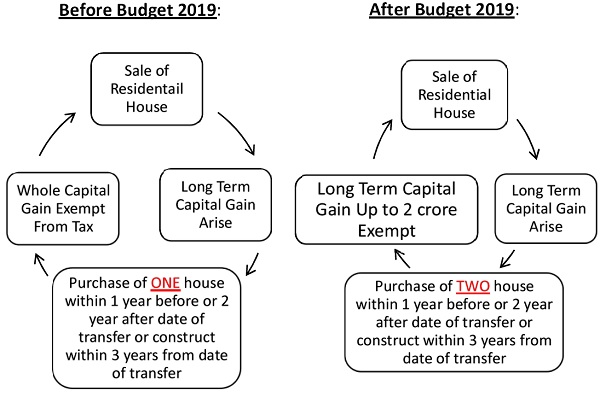
How Claim Capital Gain Exemption Invest in 2 Houses

Sale of a residential house is taxable under the Income Tax Act. When you sell a house, you are required to pay capital gain tax on the profit received from the sale. The Income Tax Act,1961 provides relief from tax payment in such a case under Section 54 , subject to fulfilment of certain conditions. Let’s analyze, what does section 54 talk about and how we can apply it to save tax.
Here we go:

ithin 3FOR YOUR KIND ATTENTION:
W.e.f. A.Y. 2020-21, an individual or HUF can claim exemption for investment house (i.e., can purchase or construct 2 house). This exemption ids available only if long term capital gain is upto Rs. 2 crores.
Points to be noted before we proceed:

1. The house must be purchased or constructed in India.
2. In case of compulsory acquisition, the period for purchase/ construction of new house will start from the date of receipt of compensation.
3. If exemption for investment in 2 houses is availed of, then this exemption cannot be availed again for the same or any other assessment year.
4. The new house must not be sold before completion of 3 years.
What if the new house is transferred/sold before 3 years complete?
The exemption claimed earlier shall stand withdrawn. Means, while calculating the capital gain on the sale of this new house, the exemption claimed earlier will be deducted from the cost of acquisition of new house.
So, if the 4 conditions mentioned above are satisfied, then you can claim capital gain exemption. But, HOW MUCH?
Lower of :
Amount of Capital gain vs Amount invested in purchase/ construction of new house
* Amount invested also includes the amount of capital gain which is unutilised and deposited in Capital Gain Deposit Account Scheme on or before the due date of filing return of income. Means you can claim exemption for deposited amount also. You can use the deposited amount within 2 or 3 years as mentioned in the section for purchase or construction of the house.
What if the amount deposited is not utilized for purchase/construction of new house?
The amount unutilised and already claimed as exemption will be taxed as long term capital gain for the year in which the period of 2 or 3 years expires.
Let’s analyze Sec.54 with some basic questions
Q 1. What should be the period of holding of house property to consider it as Long term capital asset?
– 24 months
Q 2. Can a person other than an Individual / HUF claim such exemption?
– No
Q 3. An Individual sold a shop owned by him and purchased a new house. Can he claim exemption on capital gain u/s 54?
– No, asset sold must be a residential house.
Q 4. An Individual sold a house and purchased a plot of land. Then he constructed a house on it. Can he claim exemption on capital gain u/s 54?
– Yes, because it’s construction of residential house.
Q 5. An individual sold a residential house owned by him and purchased a shop. Can he claim exemption on capital gain u/s 54?
– No, asset purchased/constructed must be a residential house.
Q 6. An individual sold a residential house owned by him and purchased 2 houses in the previous year 2019-20. Capital gain amounted to ₹3 crores. Can he claim exemption on capital gain u/s 54?
– No, because the amount of capital gain exceeds ₹2 crores. Exemption for investment in 2 houses is available only if capital gain is up to ₹2 crores.
Q 7. An individual sold a residential house owned by him. Capital gain amounted to Rs. 5 lakhs. He deposited Rs. 5 lakhs in the Capital Gain Deposit Account Scheme as he was not able to utilize it for purchase/construction of residential house before the due date of filing return of income and claimed exemption u/s 54. Next year, he withdrew the money to purchase some gold. Will the exemption granted be revoked on purchase of gold from the money withdrawn from the scheme?
– Yes, exemption will be revoked and the exemption granted earlier will be charged to tax as long-term capital gain because of the fact that the withdrawn money was utilized for purchase of asset other than residential house.
Q 8. Can an individual/HUF claim capital gain exemption on purchase or construction of a residential house outside India?
– No, the house purchased or constructed must be situated in India.

Need any assistance than 


Anti-profiteering

Anti-profiteering Today we are discussed about the most important topic that is the benefit of Gst will be transferred to the ultimat...